Sponsored by EwingCole.
In the heart of West Philadelphia, there is a 350-acre, historic public golf course. Cobbs Creek was established in 1916, but over its 110-year history, it had fallen into disarray and had been reclaimed by flooding and overgrowth. Today, the greens, fairways, and facilities look far different as a multi-year restoration and expansion project has diligently reinvigorated the Cobbs Creek campus. The Cobbs Creek Foundation, leading the project, has lofty goals to transition the grounds from just a golf course to a dynamic education and recreation campus that serves as a lever for societal change. Part of this mission was to create inclusive spaces that invited the public regardless of their interest in golf. A core facility shaping that mission is the Lincoln Financial Center.
The Lincoln Financial Center includes a 68-bay driving range, Little Horse Tavern, serving upscale classic American fare, and a fully-stocked pro shop. For the foundation, it was vital for this space to reflect the mission of inclusivity and history. “The driving range building, for lack of a better word, is a community center,” says Don Dissinger, the director of project development for Cobbs Creek Foundation. “The interior architecture needed to be public and inclusive, it did not want to be private and exclusive.”
Beyond restoring the course, any design firm helping with the project would need to balance a mission of inclusivity, recreation, and history. This was why Dissinger, golf historian Andrew Mutch, and the Foundation knew it was vital to partner with the right firm to provide the programming, space planning, and interior architecture of the Lincoln Financial Center, which would serve as a community gathering point. “We chose EwingCole because they knew how to tell stories before they designed things,” Dissinger says. “They helped create a story that would link the iconic public to a place and create a pathway from its history to its future.”
While golf anchors the campus, food, beverage, and flexible gathering space give the Lincoln Financial Center a life beyond the tee box. The building’s program resonates across three levels: a ground-floor pro shop and forthcoming Heritage Center museum; the Little Horse Tavern and driving range bays at the heart of the structure; and a divisible upper-level event space for community, school, and celebratory functions.
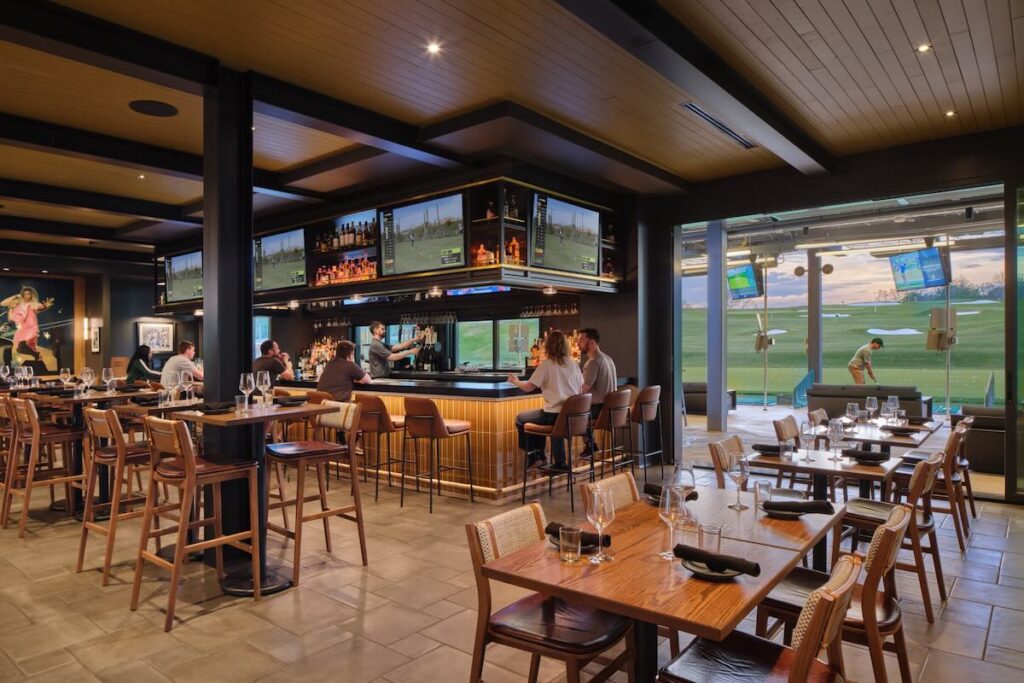
EwingCole designed the restaurant to be more than an amenity; it serves as the building’s gathering space. “The restaurant is the social engine right on the middle floor,” says Bill McCullough, AIA, principal and director of EwingCole’s Sports & Entertainment practice. With views overlooking the range and the Philadelphia city skyline, the space invites guests to meet with friends or take in the facility’s energy without ever having to pick up a club.
At arrival, the Cobbs Creek mark is cut from blackened steel and backlit against a stone wall. Beyond it, a large-scale line drawing of the historic course routing does the work of wayfinding and ornament at once, inviting visitors upstairs. From there, EwingCole trades the formality of the traditional clubhouse for something closer to a well-made neighborhood tavern. A tight palette of white oak, blackened steel, and stacked stone, referencing the old mills that once occupied the site, carries throughout, with heavy oak portals framing the room and drawing the eye to a floor-to-ceiling fireplace. Full-height operable glazing dissolves the wall between the dining room and the hitting bays. Local character grounds the rest: a restaurant mural by a Philadelphia artist Arthur Haywood via the Philadelphia Mural Arts program, shaped by community feedback, honors the neighborhood’s shared history and heroes, while restroom wallpaper of Benjamin Franklin blowing a bubble adds a playful, endlessly photographed touch.
These elements are set against a backdrop of durable materials that convey polish while standing up to the rigors of a public facility. McCullough notes that this hospitality-first mindset is what creates an emotional connection with visitors: “We talk about hospitality in terms of experience—what you see, what you touch, what you feel is very important. When you’re in the field of hospitality design, you know where to create these moments.”
Early response suggests the strategy is working. Visitors are increasingly using the Lincoln Financial Center for dining and events independently of the sport. Cobbs Creek has evolved into a model for how public restorations can move beyond traditional boundaries to become engines of community engagement. For the project team, the strength of the project lies in how these diverse uses, from education and environmental restoration to upscale dining, interlock to serve a common goal. As Dissinger puts it, the success isn’t found in any isolated feature, but in the cohesion of the whole: “There’s no one thing. But everything relates, and I think that’s the art of this design.”
To learn more about the Cobbs Creek Renovation and EwingCole’s design projects visit their website.




Tell Us What You Think!
You must be logged in to post a comment.