Working in marketing and media for the last 30 years, Jeff Lambert was accustomed to visiting great clubs and event venues around the world. He loved how those spaces opened the door to new people and fresh relationships, but as he looked around his home in Grand Rapids, Mich., he realized downtown didn’t have anything like that.
Lambert shared the concept with clients, friends, and local business and community leaders who immediately saw the potential for a destination like the Commerce Club in West Michigan. Their feedback and enthusiasm helped the idea take shape.
Located in the historic 61 Commerce building in the heart of downtown Grand Rapids, the six-floor, 30,000-square-foot private club has been meticulously designed, with a renovation costing an estimated six to eight million dollars, to deliver a curated membership experience for leaders in business, lifestyle, and community.
Finding Founders
According to Lambert, Commerce Club stands apart from traditional clubs because it has about 50 co-founders who buy equity in the club, ultimately making them owners.
“These 50 or 60 founders we have on day one will be with us forever, and they’ll serve as our governing body,” he says.
It was important to Lambert that these founding members come from diverse backgrounds and experiences, blending different perspectives into one shared space.
For example, Rylee Kellogg, Chief of Staff of Commerce Club, is also a co-founder. She spent 17 years in the entertainment world, working as a tour manager, artist manager, and in other roles across the music industry.
“I traveled to 89 countries, stayed in a lot of five-star hotels, and visited many private clubs,” Kellogg says. “When I moved back home, I wanted to find a place that resonated with me. I wanted something cool, diverse, well-connected, and a good place to network and grow. There wasn’t anything like that here.”
Lambert says finding co-founders and investors has been the biggest hurdle so far.
“Raising capital on an idea and pitching people with a PowerPoint deck was a challenge,” he says. “People agreed with the vision and were excited about it, but getting them to write checks for an idea is tough. It’s become easier in the past few weeks because everything is moving forward, but we’ve been very intentional about under-promising and over-delivering.”
As the club has continued to take shape, it has become easier to bring more people on board.
Choosing Amenities
The Commerce Club is being built in phases, with Phase One beginning in the first quarter of 2026.
Lambert says he launched the project by forming a small core group to guide key decisions.
“We had the building and the flexibility to create certain things, and we had the capital to start,” he says. “But we needed to align around the core idea, which was a club experience exclusive to members, yet accessible through events to guests and the broader public.”
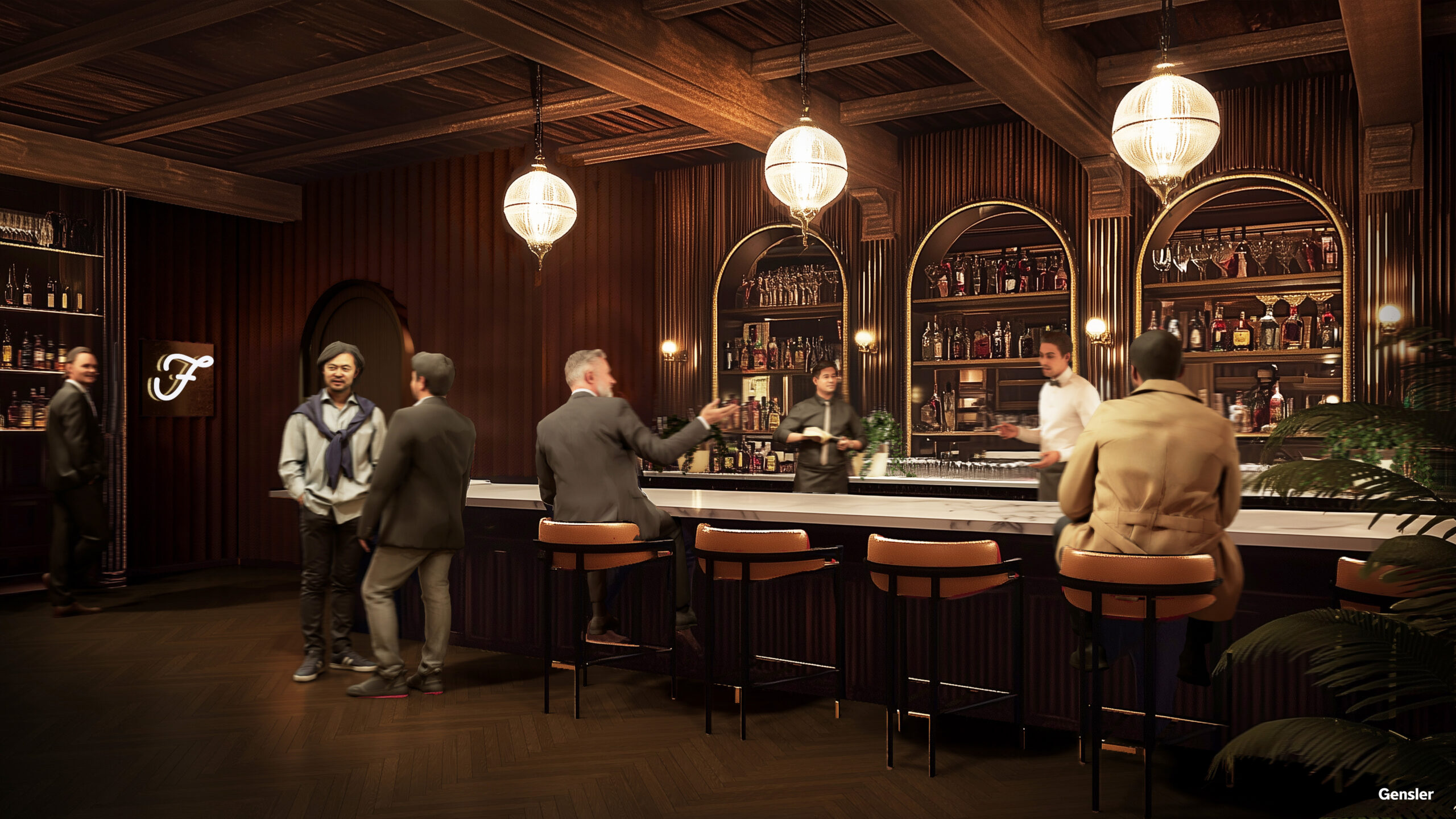
With that framework, the group agreed an event space was essential. They also prioritized a speakeasy and cigar lounge, and, to keep the club active throughout the day, a coffee café.
They also realized that offering overnight rooms would be important for reciprocity.
“We believed overnight rooms were critical for recruiting and hosting people from out of town, whether they were clients, colleagues from other markets, or guests we wanted to bring into the community,” Lambert notes. “These rooms were always part of the plan.”
The club worked with Gensler in Chicago to define the initial amenity set, and Lambert says he and the founders are now refining those details.
Phase One plans include:
- Opening Bell and concierge: A main-floor coffee and juice bar designed as a central social hub and meeting spot, supported by a dedicated concierge.
- The Mint: A second-floor event venue where members can host business and cultural gatherings, from product launches to wedding celebrations. The space will also support a full calendar of member experiences, entertainment, and curated events.
- Spring Street: A third-floor workspace with private offices, meeting rooms, co-working areas, and a multimedia and podcast studio.
- Founders Suites: Eighteen private suites on the fourth and fifth floors for overnight or extended stays for members and their guests.
- Currency: A lower-level speakeasy with a cigar room, outdoor patio, wine cellar, and chef’s table, offering a refined setting for celebrations or quiet escapes.
A wellness center is also part of Phase One, focused on personal training, IV therapy, cold plunges, massage, and related services.
Phase Two will introduce indoor and outdoor rooftop spaces, a full-service restaurant, and additional amenities shaped by the evolving needs of founders and members.
“Our hope is that you start and end your day at the Commerce Club,” Lambert says.


Unique Membership
Kellogg says she has spoken with many tastemakers in the Grand Rapids area, and they’ve all echoed the same sentiment: a concept like this has been missing from the city.
She’s focused on building the club the right way by diversifying the membership base and bringing in the next generation alongside the established leaders already active in the community.
To make the club truly distinctive, Lambert and Kellogg are putting membership at the center of the strategy.
“Membership shapes any club’s culture, and it’s a real challenge to build a group that’s genuinely diverse and serves people from different backgrounds,” Lambert says. “Our intention from the start was to have diverse founders, knowing that it would translate into a diverse membership. This will be a membership unique in its breadth and background.”
Lambert says the founder-owned structure, combined with a commitment to diversity, may become a model other clubs want to follow.
He and Kellogg are also working to attract younger members—what Lambert calls “the cool kids”—because he believes the next generation has to buy into the vision first for it to thrive.
“Our focus is to deliver on the promise of a club that offers something for everyone while still feeling exclusive,” Lambert says. “Our events will range from galas and black ties to a Friday night rave. I don’t think we’ve had anything in this area that brings people together across backgrounds to learn and grow from one another.”
The club will offer two types of membership: founder members and regular members.
Founder members are owners, limited to those who invest at the outset. Lambert says the group of 50 or 60 founders will remain fixed.
Regular members will follow a more traditional structure, paying annual dues and a minimum spend.
Founder members receive dedicated lockers, first access to overnight suites, and the ability to lease those suites and receive revenue share. They also hold the authority to nominate other prospective members, which will drive membership growth for the first two years.
Lambert and Kellogg initially hoped to open with 250 members, but interest has pushed their target closer to 300 or even 400.
“We want Commerce Club to have a meaningful impact on Grand Rapids and on its members,” Lambert says.
Kellogg adds that another goal is to break the stereotype of what a private club represents in their community.
“It’s not going to be a place where people come only to make moves on the skyline,” she says. “We want real community leaders who are working for the betterment of the city, not just the betterment of our members.”
“If you don’t do anything in the community with the resources you’re given, then it’s just a transaction,” Lambert agrees.
Success, they both say, will be measured by how well the club supports the community. The plan is to partner with local projects, support nonprofits, and host nonprofit events as part of its mission.