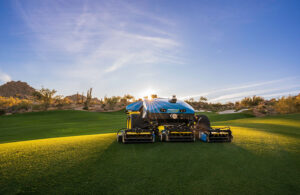
The next major innovation in golf course maintenance may not be a new grass variety or irrigation system. It could be a fleet of robotic mowers quietly cutting turf while maintenance teams focus on other priorities.
That’s the direction Concert Golf Partners is heading as it introduces robotic mowing technology at several of its courses across the country.
Testing the future of turf maintenance
Danny Gwyn, Senior Vice President of Agronomy across all Concert Golf Partners locations is leading the charge in the company’s adoption of this new technology.
Gwyn says the company started experimenting with robotic mowers around five years ago with smaller units that are still running at many clubs today.
“Our goal was to figure out what application would be good for us,” says Gwyn.

Danny Gwyn, Senior Vice President of Agronomy across all Concert Golf Partners locations.
The company found the smaller robotic mowers have been useful for common grounds and clubhouse grounds. Once the company got comfortable with the technology on a smaller scale, Gwyn decided to look at larger scale robotic mowers.
The robotic mowers operate using GPS guidance and satellite positioning. Through this, the mowers follow predetermined routes and mowing patterns.
The decision to implement robotic mowers came down to two key factors, says Gwyn.
“We feel that this technology is coming to other markets and we need to get ahead of this movement and get comfortable with the technology,” says Gwyn.
He sees interest in these mowers from state or local municipalities as they work to move away from gas or diesel powered motors.
“California, for example, has already implemented legislation to get rid of smaller tools that we use on the golf course that are gas powered,” says Gwyn.
Another driving factor behind the implementation of the mowers is challenges with labor in the industry.
“Finding quality staff has become even more difficult,” says Gwyn. “Trying to make staff members as efficient as we possibly can is critical for us.”
The robotic mowers require observation but don’t require the hands-on work that comes with traditional equipment, freeing employees to focus their attention on other projects.
“The beauty of the mower is that the staff member can set the mower up on the first hole in the morning and go do a hundred other things while that mower is running,” says Gwyn.
However, the mowers aren’t fully independent. Staff members have tablets that can see exactly where the mower is. The mower also will not cross a roadway on its own.
“When the mower is ready to move across the street, the employee gets notified on the tablet, can see exactly where the mower is and they can move it to reduce liabilities,” he says.
Four clubs, four test cases
Concert Golf Partners has introduced this new technology at the following courses:
- TPC Monterey at Pasadera in Monterey, Calif.
- The Hawthorns Golf & Country Club in Fishers, Ind.
- Plantation Golf and Country Club in Venice, Fla.
- Heathrow Legacy Club in Orlando, Fla.
Heathrow Legacy Club was the first location Concert Golf Partners rolled out this technology. The rollout was intentional because the property is home to the company’s corporate offices.
“I wanted people at Concert to see it and understand it mattered,” he says.
The next course Gwyn sent the technology to was TPC Monterey because of California’s evolving equipment regulations.
These courses were also chosen based on their location and the type of turfs used.
“There are two distinct types of turf we use on golf courses, either a cool season turf or a warm season turf,” explains Gwyn. “So I chose the other properties so I could get separate sets of information from two warm season courses and cool season courses. We were able to see the quality of operation the technology will give us on those different types of grass.”
A growing role for autonomous equipment
Compared to traditional mowers, this new technology has many advantages.
“These new mowers have no fuel, no hydraulic fluids, so no potential leaks, and no oil,” he says. “It minimizes a lot of those maintenance things we have to constantly deal with and so far they’ve proven to be very user friendly.”
Gwyn says he received a note from his grounds employee at Heathrow about a month ago telling him that the new mower has been running for about a year and he believes it provides a better quality cut than a traditional gas-powered mower.
Because of all these advantages, Gwyn believes this technology is the future although he doesn’t believe the industry will ever be able to walk away from manually operated machines.
“We may get unfortunate weather patterns where we get a ton of rain and the autonomous mowers don’t recognize that they may be mowing in an area that is too wet,” says Gwyn. “A manually operated mower would have an operator that could visually tell what areas are too wet for a cut.”
As the industry gains confidence and becomes more comfortable with this technology, Gwyn believes more clubs will start adopting this technology.
He anticipates that three or four more of these mowers will be implemented at other Concert Golf Partners locations within the next year.