

Chris Bessette, Golf Course
Superintendent, Furnace Creek Golf Course
Chris Bessette provides great golf conditions and preserves a fragile environment at Furnace Creek GC in California’s Death Valley.
Chris Bessette was raised in upstate New York, but headed west as a young man to California seeking greater opportunity. “The economy in New York was not great, and the winters were terrible,” he explains. “So I packed up and headed to California to get a job and escape the snow. I had a biology degree, but I started in retail management. I got tired of that, and decided to pursue the golf industry.”
In 1993, Bessette earned a degree in turf management from the College of the Desert in Palm Springs, Calif. His career progressed up the ladder at various golf facilities, from intern to crew member to assistant to head superintendent. Then he saw an advertisement for a golf course in the desert, a few miles west of the California/Nevada state line. But not just any desert—the course was Furnace Creek (Calif.) GC, located in Death Valley, the hottest place in the U.S., with an average daily temperature in July and August of 115 degrees. And other months aren’t much better: The highest recorded temperature in U.S. history was 134 degrees on June 19, 1913, measured a quarter-mile from Furnace Creek.
Super in the Spotlight:
Chris BessettePosition: Golf Course Superintendent, Furnace Creek Golf Course |
It certainly didn’t sound like a place anyone would want to move—especially a golf course superintendent, considering that the elevation at Furnace Creek is 214 feet below sea level, and the average rainfall is an inch and a half per year. And the nearest town of any size (Pahrump, Nev.) is an hour away.
But Bessette was curious enough to have his wife send in his resume in response to the ad. A few weeks later he got an invitation to visit. He did some more research and was intrigued by the history of the course, which was created after borax mining began in the region in the early 1900s. The mining company built a resort for officials and guests, so there was a need for entertainment and recreation. Date farmers in the area built three golf holes in 1927 and the course was expanded to nine holes in 1931. In 1968 William Bell expanded the layout to 18 holes, with Perry Dye renovating the course in 1997.
Bessette decided to check out the course first-hand, and much to his surprise, he discovered an opportunity to work in an environment he terms “absolutely beautiful”—and one without the hassles that many golf course facilities face. There were no adjacent home owners, no restrictions from local ordinances, and no competition from other facilities. Smitten on the spot, he told his wife he wanted to take the job. Snowflakes would now become an even more distant memory. And 13 years after his move to Death Valley, C&RB caught up with Bessette to get more insight into the unique challenges involved with turf management in such an extreme environment.
Furnace Creek (Calif.) Golf Course
Q: What impact does Death Valley’s heat have on Furnace Creek’s maintenance staff and schedule?
A: We have eight full-time staff members, but there is considerable turnover. Plus, it’s hard to attract workers because of the remote location and the heat. Staffing is my biggest challenge; we take every precaution possible to make sure our staff is hydrated and protected, and once it hits 123 degrees I send them home. It might be a “dry heat,” but at that point productivity wanes.
Even though we don’t have much summer play, we maintain the course year-round because we do have some guests—and the General Manager of the resort plays golf. Plus, it keeps us sharp and focused.
If you’re not from around here, it takes two years to get used to the heat. The first year was tough for me, but now I love the heat. On winter nights when it gets down to 40 degrees, I think it’s freezing.
Q: How do your course maintenance programs differ from what others face?
A: I don’t face the disease pressures that others do. We have had a little “fairy ring,” but not much. A couple of years ago we started seeing some issues, and we had a lab analyze our turf. It turned out to be curvularia, a fungus that is found more in the tropics. When we hit the magic number of 150, for temperature and humidity combined, we do some preventative spraying.
We do not fertilize as much, either. We treat the entire course when the grass comes out of dormancy with a granular application, and then again once before the end of the season, to give turf a chance to store nutrients. We hit the greens multiple times with a liquid fertilizer.
Course Profile
Furnace Creek Golf CourseWebsite: www.furnacecreekresort.com 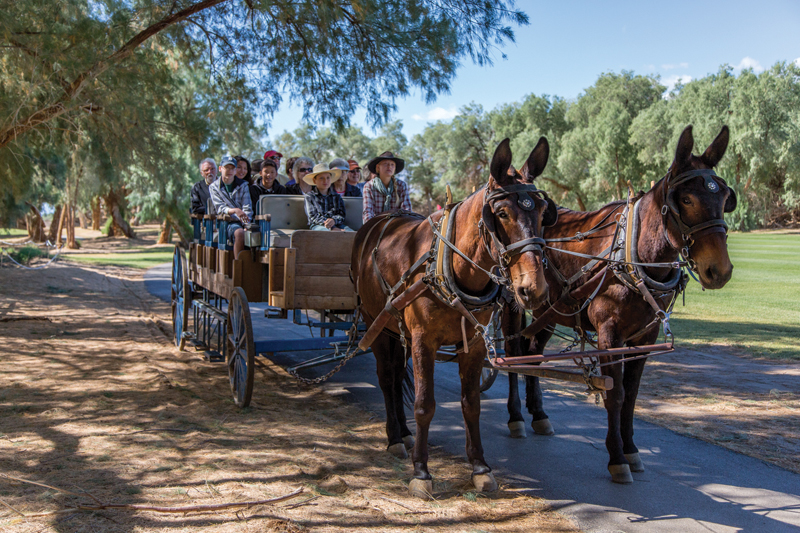 Furnace Creek (Calif.) Golf Course Type: Resort (part of Furnace Creek Resort, a property owned privately by Xanterra Corp. in Death Valley National Park). |
Q: You quit overseeding about six years ago. Why?
A: Overseeding in our environment has always been hit-and-miss, in terms of coming out of transition. There were times when the Bermuda would be weakened and it would struggle the rest of the year. Plus, we got some complaints that our greens would be too slow, because we raised mowing heights to compensate for the heat.
I did some research on courses that paint greens and decided to try that one year, instead of overseeding. We only did greens at first, but then decided to do tees, greens and fairways. We paint in December, then touch it up coming out of dormancy in March or April. The feedback has been great—in fact, some think our greens might be too fast when they’re painted. It saves time and money, and I think it’s better in the long run for our turf.
Q: Is water management a challenge?
A: The resort is fed by a spring. The water first enters our two swimming pools, and then circulates to our ponds. As you might expect, there are a lot of minerals and it has a high ph—8.5. That is not good for the grass, so we use a sulfur burner to lower the ph to 7.0.
The National Park Service controls the amount we use, with a set monthly allowance that is the same year-round. We have plenty of water in the winter months, and not enough in the summer. To compensate, we do not water the roughs and driving range during the summer.
Q: How does the course play?
A: It made Golf Digest’s top 50 most difficult courses to play, because of the heat. I like to play twice a week, but if it gets above 120 degrees I will not go out. The course is only 6,236 yards, but because we are 214 feet below sea level, the ball does not travel as far. They say drives go 10 to 20 fewer yards than at sea level. The fairways are generous, but the greens are fairly small.
We used to host an event in June called the Heatstroke Open. The first one drew 48 players from around the country. We hosted it two more years, but the novelty wore off and we do not conduct it anymore. It is truly a unique course and one that is fun to play.
Q: What do you do as a member of the Audubon Cooperative Sanctuary Program?
A: I saw a brochure about the program and at first did not think we could qualify. But after doing more research, I saw there were elements of it that we could execute.
We first began a water conservation program. I kept daily water-use records from the moment I got here, so I knew where we could cut without sacrificing quality.
We also added places for bird-watchers. We took some turf out of non-playing areas and put in wildflowers and other vegetation. We also put up bird-watching stands away from play. Twice a year, I have bird-watchers come out and document the types of species on the property. At certain times, we have as many as 150 different species. We get quite a few guests from the resort who come over not to golf, but to watch birds.
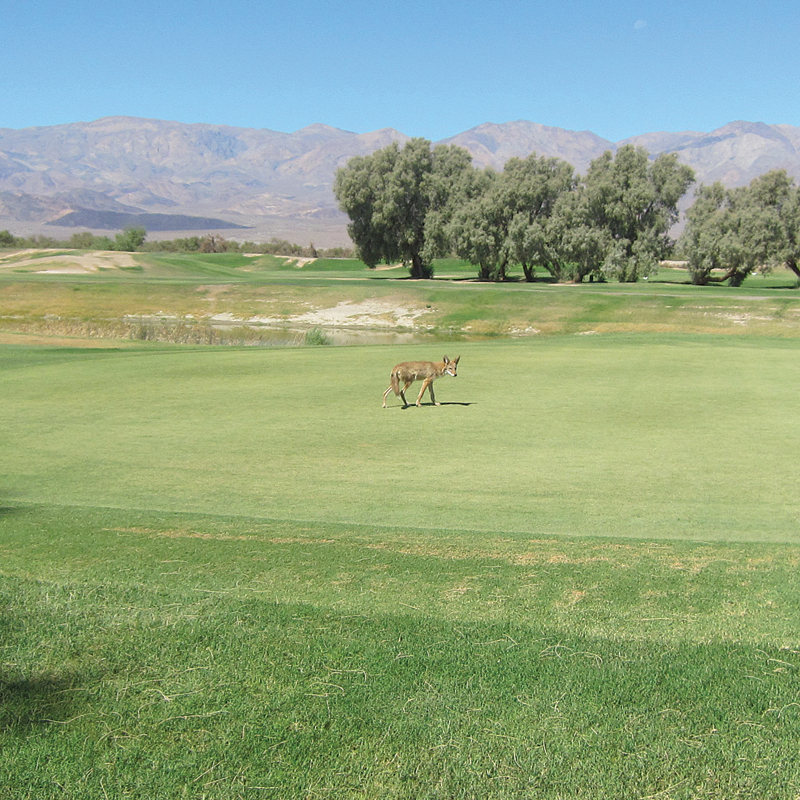
Other wildlife are coyotes, roadrunners, snakes, lizards and rabbits. About a dozen coyotes roam the course [see photo above], but they don’t bother anyone.
Q: What other environmental practices do you execute?
A: We take all of the animal fat and cooking oil from our kitchens and recycle it to create biodiesel that we use for two mowers. We used to pay to have 100 gallons of the oil picked up and disposed. But we found a unit that makes biodiesel at one of our properties at Yellowstone National Park, and brought it here. We will also have a composting unit ready to go in the near future; we will combine food waste, horse manure and newspapers to create compost for use on the course.


Tell Us What You Think!
You must be logged in to post a comment.